Creative Chats Conference, Panel 2: Organizations & Systems
How do we support a healthy local arts ecosystem?
This was the question that drove the first Creative Chats Conference that happened at the Mosesian Center for the Arts on June 4th, 2026. This recording is from the second panel of the event that focused on shaping local arts organization and systems. The interactive panel featured 3 panelists and their questions:
Allie Fry (Programming Librarian, Watertown Free Public Library) - How do we make it easier for artists to pitch their ideas (in the right way to the right places)?
DeWitt Henry (Writer and Watertown Lit Squad Organizer) - How do we garner attention for forms of art beyond the most popular local mediums?
Jan Taylor (Fundraising Strategist & Consultant) - What does it mean to be creative if you’re not the one making the art?
The conversation was also aided by Sheri Kennedy, a local artist and graphic facilitator, who graphically notated the panel discussions to provide us with some visual overviews and notes to see as we went along. The episode image features the drawing she did while listening to this panel.
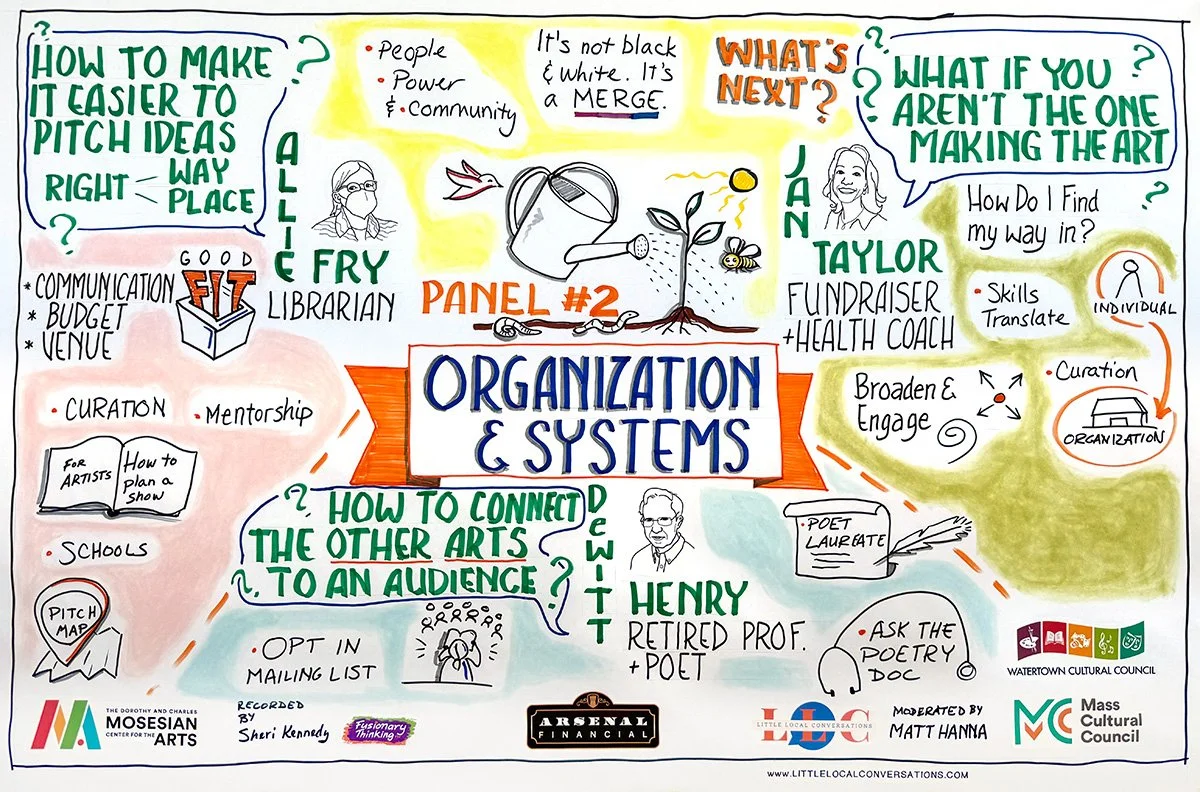
Graphic recording of the panel done by Sheri Kennedy.
Listen to the first panel of the conference on the topic of Art & Money.
Listen to other Creative Chats episodes.
—————
Sign up for the Little Local Conversations email newsletter to know when new episodes are out and keep up on everything Little Local Conversations.
Thanks to podcast promotional partner the Watertown Business Coalition, a nonprofit organization focused on connecting local businesses and strengthening our community. Check them out at watertownbusinesscoalition.com.
Thanks to promotional partner Watertown News, a Watertown-focused online newspaper. Check them out at watertownmanews.com.
Thank you to Creative Chats series sponsor Arsenal Financial!

This program is supported in part by a grant from the Watertown Cultural Council, a local agency which is supported by the Mass Cultural Council, a state agency.
Transcript
Matt 0:02
Hi there. Welcome to the Little Local Conversations Podcast. I'm your host, Matt Hanna. Every episode, I sit down for a conversation to discover the people, places, stories, and ideas of Watertown. This episode is a recording from a special event back in June. I've been doing Creative Chats events over at the Mosesian Center for the Arts for two years now. Creative Chats events have been a way to gather creative people in the community face to face to mingle, hear a future conversation on the topic of creativity and the creative life, and then engage in the conversation themselves. It's a way to get inspired, reflect, and connect within our local creative community. And to close out the second season, we had a special event, the Creative Chats Conference, which was a four-hour event which featured two panels. And the overall theme of the conference was how do we support a healthy local arts ecosystem?
Matt 0:49
The first half of the afternoon featured a panel and small group discussions around the topic of money in the arts, specifically how do we value art, get it funded, and connect with a buying audience. I've already released an episode for that part of the conference, so you can find it back in the podcast episode listings, and I'll also link to it in the show notes. But today's episode is from the second half of the afternoon, which focused on organization and systems, with a panel featuring programming librarian Allie Fry, writer DeWitt Henry, and fundraising strategist and consultant Jan Taylor.
Matt 1:23
Before we dive into the episode, I want to give a few super quick thank yous. First, the Mosesian Center for the Arts for hosting two years worth of Creative Chats events. Thank you so much to the Mosesian Center for giving us space to have these conversations. Secondly, I wanted to thank the Creative Chats series sponsor, Arsenal Financial, which is a financial planning business in the city run by Doug Orifice, who is a big local arts lover and supporter. So I'm very thankful for Doug and his team for sponsoring these events. I also want to give a big thank you to Sheri Kennedy, who was at the event graphically recording it for us. If you look at the episode image, you'll see the picture that she was drawing during these conversations, which captured some of the key points. So thank you, Sheri, as well for being part of this. If you're interested in her work, you can find her at fusionarythinking.com. All right, so let's get into the conversation on organization and systems in local art. Hope you enjoy.
Matt 2:12
So welcome everybody. If you were not here for the first half, this is the Creative Chats Conference. We just had a panel earlier that was about art and money. And Sheri here did a great job of graphically recording it for us. And it will also be released later on the podcast, Little Local Conversations. I'll share that later. But for this second panel, I have some new people and one holdover, returning guest from the first one. And Sheri will be helping us out again. So this panel, it kind of flows nicely from that first conversation of art and money, because the second thing that's important after that, okay, great. We have all these ideas. How do you make that happen? You need organizations and you need systems.
Matt 2:56
And the full title, which was a mouthful, thank you, Sheri, for not putting the full title on there. I put, organizations and systems, how to create connections between artists with other artists and to arts organizers, and how to build systems that encourage a diverse array of types of art. So there's a lot to unpack there, but each of our panelists came in with their own topic that they will introduce and introduce themselves a little bit. And then if you were here for the first time, we'll split out into three separate groups. And each of the panelists will have 10 minutes in each group where you can talk on their question. Then the panelists will switch so you get to talk to each of the panelists, and then we'll come back and have closing thoughts on what came up in those conversations and hopefully some things to look forward to about moving forward with some of these ideas.
Matt 3:41
So I'm gonna start with Allie. I'll go down my list here. So, Allie, do you want to introduce yourself and do you want me to read your question or do you have, you're okay?
Allie 3:49
I've got it.
Matt 3:50
You got it. Okay. So go ahead, take it away.
Allie 3:52
Thanks, Matt. My name is Allie Fry. I am the programming librarian at the Watertown Free Public Library. The question that I'm bringing today is how do we make it easier for artists to pitch their ideas in the right way to the right places? And artists in a very broad sense, whether you're a writer, I've worked with DeWitt a few times now, whether you are a visual artist, whether you're a performer or a musician. A common problem I run into as an arts administrator, someone who has the great pleasure of working with local artists and performers and presenters, is that I often get an influx of, we have such a wealth of artists here, and I couldn't possibly book them into every slot of the library's calendar. It would be incredible if we could. We sometimes have budgetary limitations. Sometimes we have space limitations. Sometimes the grand idea that someone is pitching would be incredible for the black box theater of the Mosesian. And I suggest that to them.
Allie 4:54
Sometimes a musician is pitching something, and I think this would be really great for our summer concert series at Saltonstall. But you are well like out of the realm of the budget of the public library. Sometimes someone wants to do a summer concert and then they get suggested to the library, and then awesome, you're a great fit for me. But I imagine it can be frustrating to artists to get tossed around, and it can be frustrating for administrators or people booking them to try to find the right fit. And is this a communication issue? Is this a we're not sure what resources are available to each other? Is this a just some people have the institutional knowledge, some people don't?
Allie 5:34
And I think we also see when it comes to institutional knowledge that there are people who are really savvy. And that often comes with people who have a lot of privilege, people who maybe have lived in Watertown for a long time, can afford to be homeowners, maybe are well connected in the community and know where, who to go to and feel very comfortable asking for help. And then there are lots of people who are super talented, but don't feel that they can ask for help or feel like that would be very entitled to ask that. And so I try to kind of go out and also nurture new talent. And so I think those are the questions I'm really interested in because I run into them all the time. And I'm hopeful that there are people who are also interested in those questions. And that's what I'm bringing to the table today.
Matt 6:21
Awesome. Thank you, Allie. So keep that in mind when you were talking with Allie in your breakout group. DeWitt, would you like to introduce yourself and your question, which I know you're gonna come at from your angle, but in general, was how do we garner attention for forms of art beyond the most popular local mediums? And you as a writer obviously have a particular angle on that, but do you want to introduce yourself and how you interact with that question?
DeWitt 6:45
Well, I moved from college or graduate school to Watertown about 50 years ago. And I've lived here since. And I suppose my confession at this point is that I'm an emerging octogenarian poet with four books and a fifth coming out since I retired from teaching both creative writing and Shakespeare and a lot of other stuff in Emerson College. I also early on, I was the founding editor of Ploughshares Magazine, which has been sustained for 50 years, is now part of Emerson, but is probably the leading or one of the few leading literary magazines in the country. 9,000 subscriptions was the report I just heard. Paris Review is at 5,000. So it's widely read and respected, and it's my grandchild, and I'm proud of that. And it was in Watertown for 15 years in a storefront on Waverley Avenue, where it wasn't understood by the community, particularly those who were under the age of sixteen, who thought it had something to do with the library. I mean, some remarkable people came through town to have lunch on that block in Waverley, including Raymond Carver and Seamus Heaney. Later on it moved into Emerson.
DeWitt 8:03
The library and the kind of writing that is the art that matters to me is educational in purpose. It's not commercial. It's the great divide in our national culture, the difference between public television, say, and commercial television. Between having commercials or having donors. Claiming that art is for man's sake, people's sake, that it's a a spiritual necessity and a collective service to the idea of commonwealth. Or the idea that it's entertainment, is a commodity, the writer needs to have livelihood based on that art, the agent needs fifteen percent. The bookstores have shelf space unlike libraries, but with a different criterion that shelf space must sell books.
DeWitt 8:57
So my personal instance is I've now published 20 books, I've had three agents, I have something of a reputation, but I've never gotten a royalty check in my life. So justifying my existence, even to my family, is a topic that there isn't time to even begin to scratch. But I thought maybe one way to start talking about this is when it comes to something like the National Endowment for the Arts or the Massachusetts Council for the Arts, or even our modest trickle-down cultural arts council in Watertown, what money there is needs to justify itself as a necessity to the commonwheel, to the taxpayer, as much as the library needs to justify their educational purpose. That's the obligation, that's the transaction.
DeWitt 9:50
So what happens when, I don't know what the per capita relation is between the number of books for sale in America and the actual population of America. Are we, you know, each expected somehow to be related to a thousand books? Given the last 50 years, now it's a very common thing for amateurs. I mean, I would think of myself as an amateur in the same spirit I would a golfer. That maybe actually be a better golfer than the ones making money. The technology of printing and all the rest of that, of producing a book has gotten to be openly available to everybody. So there are thousands, more than thousands, of every year, books published in America. There's no way that that many books can find readers. And so the sorting process of what's worth writing, what's worth publishing, what is authentic, or someone said earlier, bullshit, or self-indulgence, or a private expression as opposed to a public expression of experience remains open-ended and confounding.
DeWitt 11:01
And there's all this static that various mechanisms attempt to sort out. Pulitzer Prize, for instance, National Book Award, the whole idea of awards seems to be doing the reading for the rest of us, much like a librarian responding to reviews in library journal. The process when it comes to where is talent and where is necessary writing, where is that book or poem or story that will be indelible that speaks to you or that confounds you enough that you start thinking about something that you're grateful that such a book exists. I think most of us have horizontal and lateral sympathies. The horizontal one is with most bestsellers, hey, I read this. I'm part of the phenomenon of Stephen King. So you better read it too if you want to be part of that phenomenon. Versus the private book, mine, the one I always bring out, is Tilly Olson's Tell Me a Riddle, which has a vertical sales history that equals the bestsellers. The bestseller is there for a season. The vertical ends up there being forever.
Matt 12:15
So I want to make sure we have time for.
DeWitt 12:18
Yeah, I'm sorry.
Matt 12:19
Yeah, yeah, yeah. So is there any question that you want to, based on our leading question, that you want people to think about heading into their conversation with you?
DeWitt 12:27
If I were in the performing arts, if I were a painter, my visibility, my products would have a better chance of connecting with an audience in Watertown. Performing arts takes most of the pie in attempts to publicly fund art. Literature is very, is not understood. Let's take poetry as the main cause of literature. Poetry is lasting, it's important, it's spiritually justifying, blah, blah, blah, blah. It's beautiful. It's something you carry in your heart. But how do you support the poet? Well, 18 towns in Massachusetts have decided to civically appoint a poet laureate. The state of Massachusetts just, after a lot of political pressure, appointed a poet laureate. And the poet laureate's responsibility in these other towns and you can look them up online. It's their job to think of things that will help educate and identify the idea of poetry to their towns as part of the complete culture.
DeWitt 13:33
And jokingly, I thought, well, wouldn't it be great if everybody read Thomas More's Utopia? It's an old-fashioned argument for commonwheel, for commonwealth. It builds on Plato and the Republic. But the place of art, particularly statues in Utopia, is knock down the soldiers and put up the philosophers. That you can educate without propagandizing. You can decide that maybe gold is the root of all evil, and it's better to use gold as if it was stones so that nobody valued it. Anyway, that's utopian. And there are utopian things we can do for the sake of poetry.
DeWitt 14:18
A few and then I'll stop. Quickly. One, we need a bookseller in Watertown. I love the idea of Annie's, which is a chain of secondhand books that can be traded. I think we need a poet laureate. I think we need projects like poems in concrete in the sidewalk, poems on stanchions, poems on billboards and buses, all that kind of stuff, it's been done. But it just celebrates the idea of something that seems minimal in the larger picture of the arts. I'd like to see adult poetry pushed as much as children's books, which means adult poetry in the neighborhood bus. Just a small display.
DeWitt 15:02
I think it's important to support local writers. And we started four years ago, a group of local writers who I happen to know and others who I hadn't but I was aware of, something called the Lit Squad, with the idea that the arsenal was a military kind of thing. Lit Squad's been around for four years now. Thank God for WAM, the Watertown Arts Market, and the spirit of WAM in its idea of what is art. They have provided these writers as a group with an ability to have a reading at WAM, to have a booth at WAM, and most importantly to have the books that we're trying to launch that have been recently published by us, for sale. So we've been doing WAM for four years, and I thought in imitation of graphic arts that it was also important to have a catalog. So what I'm going to pass around is a sampler of work by Watertown writers. So the emphasis on local is part of neighborliness. And some of these writers are prestige, items, I suppose. They have won awards, they have a track record. Others are first timers, some are total amateurs. It's not edited. It's a sampler. Let me give these away.
Matt 16:25
How about when you go to your groups, you can bring them around when you go to your group.
DeWitt 16:29
Okay.
Matt 16:30
Great. So a lot to talk about there with DeWitt when you're in Dewitt's group. Now, Jan, what is your topic for this panel?
Jan 16:38
So I know many of you were at the panel before, so I'll shorten up my introduction of myself. I'm Jan Taylor, and I am a lifelong nonprofit professional. And in the middle of that bookending of my nonprofit work, I've owned and operated a local fitness studio, Get Lively Health and Fitness, that many of you may know. I'm often known as Jan Lively, as I mentioned earlier. And what I am here to talk about today is what does it mean to be creative if you're not the one making the art? So I have a question for all of you. Who in this room considers themselves an artist or fashions themselves or thinks of themselves or identifies as an artist or a creator? Oh my gosh, every hand went up except mine. Who in this room thinks about themselves as someone who is the best supporting actress of the arts? Yes. Thank you. Thank you.
Jan 17:33
So there is this really interesting tension between this idea of being involved in the arts, but not being the one who creates. And so a smidge of background. I was a theater kid and I loved performance and I went on to study performance as an undergrad and I became a fundraiser and a fitness instructor. And I often laugh that although I did not go on to create art in that regard, without that foundation, I would not be where I am today. Everything about what I've done in my life has been born of that art form. But I don't create art. And so what does that mean?
Jan 18:18
And I think the question really comes down to for me is, we still want to belong. And I love being part of organizations like this and being part of the public arts and culture committee and being able to play that best supporting actress role within a community. And I encourage you all, even though you all raised your hand as artist and creators, I encourage you still to think broadly about how the application may apply across a spectrum. And I'll just share one quick fun example.
Jan 18:52
So I'm always trying to find my way into the art world. And sometimes it's through fitness and sometimes it's through fundraising. So we have the great privilege of being part of this community. We're in Watertown. Art is valued. There's so many opportunities. So we have a Watertown walk and talk series, which who's ever participated? I know lots. Yes. And so coming up in July, I am going to be leading one of these. And what I'm going to be doing is walking us around the community murals. And we are going to be doing movement and exercise inspired by the art. I didn't paint the mural, but I'm taking what I do and playing a part in exposing people to that, giving them a way to experience it in a different way. So I'm here today to encourage you to think broadly, whether you're the creator or you're that best supporting actor or actress. I think we can all think about whether it's our artform or not. How do we broaden and engage? So thanks.
Matt 19:56
Great. Okay. So what we're going to do now is if you were here before, we're going to split out into our groups. And this was the part of the conference where we split up into small groups where everyone who was there had a chance to speak to each of the panelists on their topic and give their thoughts and ideas. We had some really productive and engaging conversations. Then we came all back together to have a closing panel discussion. So let's jump back in after we came back.
Matt 20:21
All right. Well, we're back. We're going to have some closing thoughts here. I hope everyone enjoyed their breakout groups and the conversations on each of these topics. Bring it home a little bit here to give us some closing thoughts and things to look forward to in our own minds and how we could go forward. So I'll go down the line again. Jan, run through some of the ideas that you got in your conversations.
Jan 20:41
Okay, I'm going to really work to summarize this because I had such fun stuff. So we had such a great conversation in all of our groups about the various roles that the best supporting actor can play. And in our first group, some of the things that I thought were so interesting is we had this great conversation about how creative practice, there's transferable skills that can then enhance what you do in your professional life or your personal life, that learning, if you are not a painter, taking a painting class, that there's elements of the practice of learning to paint that can then be transferred and applied in other areas. So I thought that that was so interesting.
Jan 21:20
That also dovetailed into this idea of curation and how we're all curating our lives and how do we want to add creative elements to that and what it means to support that. Another piece that came up, which I absolutely loved, was, and I just mentioned this in our last group, is someone in our first group said that one of the things that she does is adding alt tags to art on websites so that it's accessible to visually impaired people. My gosh, what an incredible supporting role to play. So this led us into conversations about the individuals and then moving into the organizations.
Jan 22:06
So how are the organizations, lots of conversations about the things that the library does, the farmers market does to provide these creative experiences for people. And of course, that led us down the path of, well, those organizations are doing that because it's fueled by the individuals saying, hey, this matters. We need to do this. Finally, we in our last group, we talked about, and we touched upon this actually in a couple of the groups, was the synergies, the mashups, how we put a creative application onto an artform and how various groups that we're a part of may come together to create something different and new that broadens people's horizons and gives us yet another perspective.
Matt 22:53
Great. A lot to take in. How about you, Allie? What were some of the takeaways from your conversations?
Allie 23:00
So many wonderful takeaways. And thank you to everybody who chatted with me. We also talked a little bit about curation, but I think curation kind of led into mentorship. We talked a lot about how there's brilliant ideas inside everybody's minds. Lots of people have different little bits of knowledge to share. So how do we get that out into the open to share to people? I want to spotlight Lynn was sharing that she had a wonderful exhibit at the library for her visual art, which she hadn't, yes. Great, great work, Lynn. And she had previously been doing theater arts. And so to get into a new medium. And then realizing once she was displaying in the gallery, she hadn't thought of a couple of things like I don't have an email list to share with people that I'm in the gallery and how exciting this is. And realizing the library will share, hey, this is what's in the gallery, but that's kind of the end of what the library does to promote the show.
Allie 23:55
So wouldn't it have been wonderful to connect with all the incredible visual artists in Watertown to say, hey, if you're going to have your first show, here are some things you might want to know about promoting the show, things you might want to have ready. Here's how you might price your art, things that you could talk about. So that was just like one really concrete, tangible example of we work with artists all the time in the art galleries, some who are really seasoned, some who are brand new. And that's the beauty of the art gallery and the library. And we have a wealth of artists who could connect and mentor each other.
Allie 24:27
I also love learning about the Secret Society of Black Creatives, where they actually first do their pitches to a curator. So people who can kind of share a raw idea first. And then once we've gone through the level of a curator, then we can pitch to the producer. So it's going to go through a couple of rounds of editing, of finessing first. And so again, thinking about working with people who have this knowledge and mentorship and shadowing from the experts.
Allie 24:54
We also came up with this idea for a Watertown pitch map. I have a great idea, who do I pitch it to? And I know we've tried that in some several iterations with the Watertown Public Arts and Culture Committee, but thinking about mapping out that ecosystem again and thinking, okay, when is the open call for exhibitions at the MCA? When are the ZineFest applications typically open at the library? When do the summer concert series applications open? When can I get funding from my local arts council? Because those are things we typically know when they're coming up. So how could I find that document or where could that live? How could that resource be something we share out? So there were lots of creative ideas about how to make this a little bit more accessible, lots of tangible, fun ideas, but a lot of it came down to we all have great knowledge. How do we connect, share, and think about where each other is coming from and build together.
Matt 25:49
Great. All right. What were some of your thoughts that came up?
DeWitt 25:53
The fewer the better. I appreciate the support for the idea of the Poet Laureate and a little bit of advice about how to contact our councilors and push that as a real proposal. And different ways that a point person devoted to local poetry could contribute with their own ideas, but also by researching what has worked in other towns. And I think the suggestion that excites me the most is the idea of a local arts patrons list. If you're interested in local arts, opt in to this mailing list. Whether there's an existing list that is already a basis for something like that, or this would be something new. But it would be an email resource. It would be a way for an isolated and not promoted and not professionally marketed artists, not just as writers but in all the arts, to announce new events, awards, publications, whatever. It would have a high standard of what is worth the attention. In Watertown, that list could be in the thousands, a couple of thousand at least. But the Poet Laureate could also connect with the other Poet Laureates around Greater Boston, and that list could be much larger, more like 25,000.
Matt 27:21
Cool. So lots of ideas here. So I'm going to do the same thing I did in the last panel. Is there any one comment or person you'd like to point out and maybe have them speak more on an idea or a point that they brought up at one of the tables? Go ahead, Jan.
Jan 27:36
Yes. Cat. Cat talked about the idea of this broader invitation to consider creative expression and what that means to us as individuals. So if you could talk more about all of those things you said.
Cat 27:54
Yes. I was trying to say that I think we separate ourselves as writers, artists, and musicians and so forth from people like you and Roberta and everybody who's doing wonderful, amazing creative work, even if it doesn't seem like it's an artform. It's still to me, you know, I said I think my definition of creativity is that we receive from spirit and we refine ourselves in our own particular way so that we receive what we receive. You know, I've been drawing since I was a little kid. It just happens to be my way, but I don't think because somebody else is doing library or somebody else is doing this or that, that that's not creative, because it is. I mean, Allie is coming here and being very creative the way she's thinking about using the library to support artists and other creative people.
Cat 28:47
So I like us to think about all of us as being creative. I mean, I get all kinds of people who come to my art classes. Most of them haven't done art since they were in third grade. Some have got higher degrees in art. And I find there's no real difference. What we learn in art, or somebody else was saying that too, it's all fostering our own continued expansion. And so I just wanted to make that point because I don't see you as being supporting actresses. I think you're the stars.
Matt 29:23
Great. So I'm gonna pose the same prompt to you, Allie. Is there any one person or thought that you wanted to expand on a little bit here?
Allie 29:30
Sure. I think if, not to put anyone on the spot, but Connie.
Matt 29:33
I will ask them if they want to be on.
Allie 29:34
I think if you're open to it, we had talked a little bit about in our first group around the role of the school and also nurturing people from a young age to feel confident. But you had shared from your own educator background and also we didn't want to put too much on teachers. And we also talked about how teachers, parents, the roles of arts institutions and where we can kind of build bridges so that nobody feels so overwhelmed, that we are putting too much onto people that are already asked so, so much. And I think you spoke really wisely about that when we talk about good fit for people who are champions of the arts from birth all the way to our hundreds.
Matt 30:16
Connie, are you okay being on the podcast?
Connie 30:19
Sure. For this, of course. And I'll try to be wise. It comes now and then. But I think this idea, as I am an educator, I worked in the Boston Public Schools, people are overwhelmed, and there are lots of good ideas. So I don't think I had this idea, but the library as a connector, but other organizations as a connector and what that might look like. I think that all ages can be involved in different ways, but we talked a lot about teens, and that's so necessary at that age to have different opportunities. I think of robust opportunities to be in conversation, to be heard, and also to listen to what advice might be given.
Connie 31:04
And I'll just say one more thing, which is there are an incredibly wonderful number of different organizations in Watertown. For instance, the schools have the diversity and belonging organizations, we have a climate group, we have different kinds of groups. We can also use children's, at all ages, their passions, to connect them to the groups through art in some way.
Matt 31:28
All right, DeWitt, do you have someone that you would like to point out that had an interesting comment or idea that you'd like to hear a little more about?
DeWitt 31:35
I'll leave it up to the someones.
Speaker 31:38
Can I nominate Barbara?
Matt 31:43
Yeah. All right. So proxy decision is Barbara, are you okay being on the podcast?
Barbara 31:49
Sure. We were talking about ways to beyond the poet laureate to bring poetry into daily life. And the idea I think you're referring to, DeWitt or Patrick called Food for Thought. Which is it's stealing from something that happens in Winchester at the farmers market where they have Ask the Grammar Doc. And this would be a modification that would be Ask the Poetry Doc. And you could approach with a theme that you want a poem that already exists about, or some help in writing a poem if you're interested in doing that. So bringing it to the masses. I love the Watertown farmers market because it probably, in addition to the schools and the library, gets the widest slice of Watertown life coming through. So it's a way of democratizing art making.
Matt 32:54
All right. So to bring this all home, if each of you could have a closing thought on your question through all your conversations. Again, I'll go down the line here. Jan, through your conversations, what new perspective do you have on your question of what does it mean to be creative if you're not the one making the art?
Jan 33:14
I no longer see a line between the two of them. It's not one or the other. We all belong and we all play a role. And I said earlier in my panel, it's not black or white, I live in the gray. And here I am learning because I was thinking of it as black and white. And now Cat brought me into the gray. So that was fabulous. Thank you.
Matt 33:33
Great. For you, Allie, what new perspective do you have on how do we make it easier for artists to pitch their ideas in the right way to the right places?
Allie 33:42
I think it all comes back to people power and community building more than any great software, email list, newfangled thing we would try, form, application, resource. The resource is the people in this room, the people outside of this room, and how we can build those bridges, which I had an inkling might be the case, but I was really happy to hear that echoed in the tables I was at.
Matt 34:10
Yeah. And DeWitt, how do you have closing thoughts on your how do we garner attention for forms of art beyond the most popular local mediums?
DeWitt 34:17
I think foregrounding the problem in a conversation like this is it's a new experience for me. And I'm grateful as a person, but in my capacity as an artist. It's a conversation that I needed without knowing it, and I hope that it continues.
Matt 34:37
Thank you. Thank you. Great. I'm gonna turn to my left. Sheri, is there any thoughts that you have to share from your experience of doing this?
Sheri 34:50
Oh, that is a humongous question. Really gratitude, just gratitude, because this is such a great community. And the fact that you're all here today on this beautiful sunny day, you could actually be at the beach and to be here talking about the arts and just how to build and grow this culture of arts and all of its many forms and formats and threads. I really, I honor all of the great minds here. And I loved hearing some of the themes that I heard bubbling up again and again, where about community and about building and growth and weaving. And it's not black or white, it's the gray. I have this now new image that I won't have time to put on here, but everything just blending in together.
Sheri 35:37
And I loved hearing some of the bits and pieces I heard from conversations about who else isn't in the room, who is not able to be here, who is not able to access the great things we already have. And I think that's a huge question that we should keep asking and keep asking. And I loved overhearing someone say that having the listening sessions with the cultures we are trying to invite is key, you know, and I would add in their language as well. So excited to see where this goes from here. So thanks.
Matt 36:06
Yes. Thank you so much, Sheri, for being part of this.
Jan 36:13
I'm gonna jump in and say thank you, Matt.
Matt 36:26
So for going forward with this, so I do a monthly series here, I'm taking a summer break, called Creative Chats. And I'd like to use this as a jumping off board for lots of things that we could do in the next series. So if you have any ideas that have come up from today, feel free to send me an email or come up to me and tell me. Because I do this once a month. It's the first Friday of the month. It'll start up in September again, probably. Well, it depends on when Labor Day happens, maybe. Yeah, so we'll figure it out. But starting up in the fall again, it'll be on the first Fridays. Again, I have my, if you want to sign up for my newsletter, it's back there. If you want to help support the podcast, that's back there. And I'm here to give people voices. So if you have any ideas about arts and culture in the city that you think should have a voice shined on it, let me know too. So thank you everyone for being here. This has been great. And thank you again, panelists. Thank you again, Sheri. Thank you, Mosesian Center. Thank you, everybody, for being part of this. It's been really great. Thank you.
Matt 37:32
So that is it for the second part of the Creative Chats Conference. Again, you can go back and find the first half of the conference, which the topic was the interaction of money and art. You can find that earlier in the podcast feed or at the website LittleLocalConversations.com. And I'll also have that linked in the show notes. And if you want to find all the Creative Chats episodes that I've done over these two years, or any of the other episodes I do for the podcast, you can find all those over at LittleLocalConversations.com.
Matt 38:03
All right, and I want to give a few shoutouts here to wrap things up. First one goes to the Creative Chat series sponsor, Arsenal Financial. Thank you again to Doug Orifice and his team. Arsenal Financial is our financial planning business here in Watertown that's run by Doug Orifice. You might know him from a handful of things in town. He's been very involved with youth sports, specifically baseball. He's the vice chair of the Watertown Cultural District. He's also the co-president of the Watertown Business Coalition. Just a really involved community member, great guy. So very happy to have him as a sponsor. And if you need help with financial planning, reach out to Doug and his team at ArsenalFinancial.com.
Matt 38:35
I also want to give a thank you to the Watertown Cultural Council, who have given me a grant this year to help support the podcast. So I want to give them the appropriate credit, which is, this program is supported in part by a grant from the Watertown Cultural Council, a local agency, which is supported by the Mass Cultural Council, a state agency. You can find out more about them at WatertownCulturalCouncil.org and MassCulturalCouncil.org. And a couple more shout outs to promotional partners, first the Watertown Business Coalition. Their motto is Community Is Our Business. Find out more about them and their events at WatertownBusinessCoalition.com. And lastly, Watertown News, which is a Watertown focused online newspaper. It's a great place to keep up to date with everything going on in the city. Check that out at WatertownMANews.com. So that's it. Until next time, take care.
