Creative Chats Conference, Panel 1: Art & Money
How do we support a healthy local arts ecosystem?
This was the question that drove the first Creative Chats Conference that happened at the Mosesian Center for the Arts on June 4th, 2026. This recording is from one panel of the event that focused on the intersection of art and money. The interactive panel featured 3 panelists and their questions:
Cat Bennett (Visual Artist and Teacher) - How can artists inspire the public to learn more about art and feel confident, even excited, about buying it?
Matt Jatkola (Associate Executive Director, Mosesian Center for the Arts) - How do we reinforce the value of art in a culture that often expects it to be cheap or free?
Jan Taylor (Fundraising Strategist & Consultant) - How do we fund art creatively?
The conversation was also aided by Sheri Kennedy, a local artist and graphic facilitator, who graphically notated the panel discussions to provide us with some visual overviews and notes to see as we went along. The episode image features the drawing she did while listening to this panel on art and money.
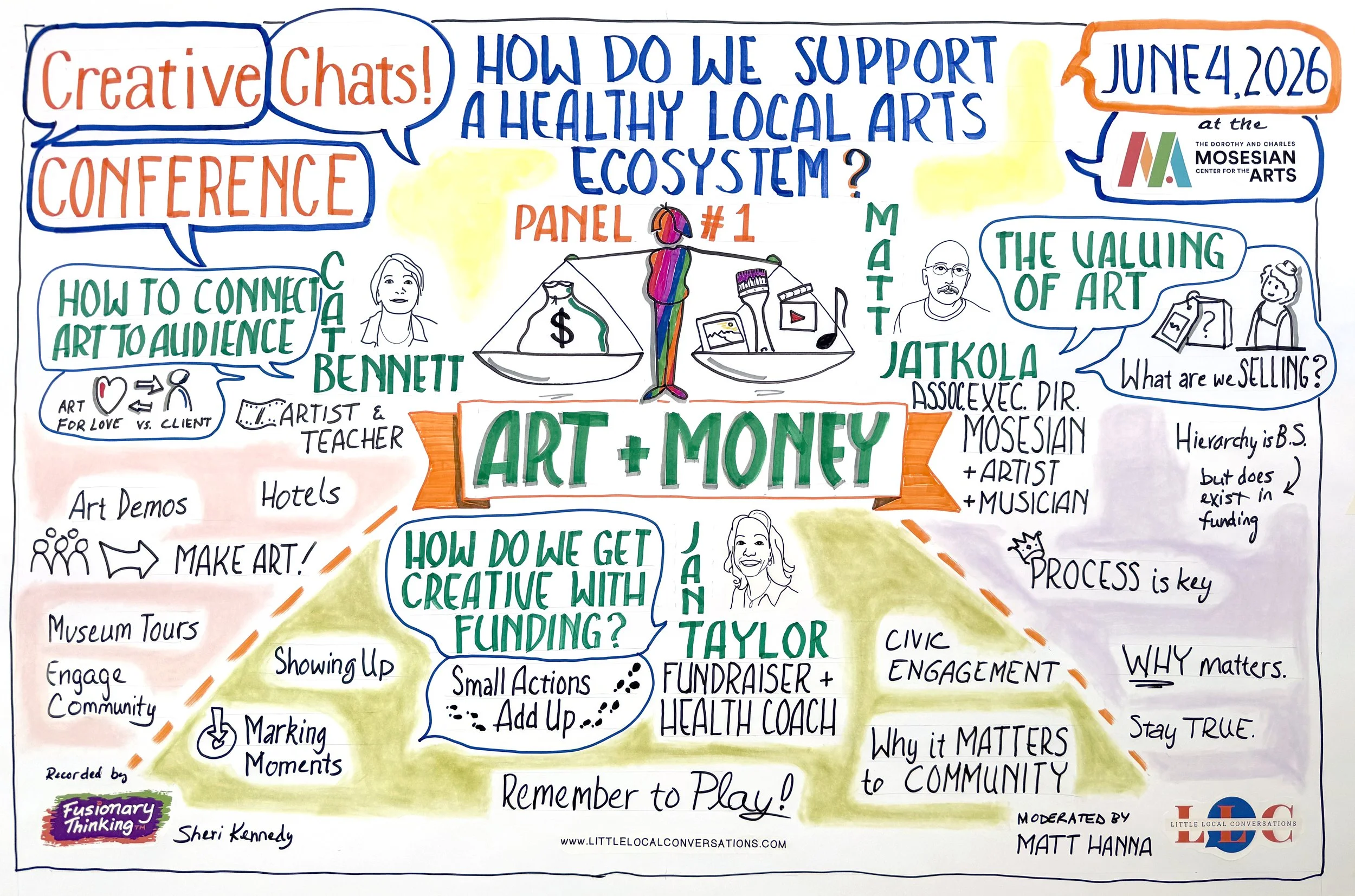
Graphic recording of the panel done by Sheri Kennedy.
Listen to other Creative Chats episodes.
—————
Sign up for the Little Local Conversations email newsletter to know when new episodes are out and keep up on everything Little Local Conversations.
Thanks to podcast promotional partner the Watertown Business Coalition, a nonprofit organization focused on connecting local businesses and strengthening our community. Check them out at watertownbusinesscoalition.com.
Thanks to promotional partner Watertown News, a Watertown-focused online newspaper. Check them out at watertownmanews.com.
Thank you to Creative Chats series sponsor Arsenal Financial!

This program is supported in part by a grant from the Watertown Cultural Council, a local agency which is supported by the Mass Cultural Council, a state agency.
Transcript
Matt 0:02
Hi there. Welcome to the Little Local Conversations Podcast. I'm your host, Matt Hanna. Every episode I sit down for a conversation to discover the people, places, stories, and ideas of Watertown. This episode is a recording from a special event I did back in June. I've been doing Creative Chats events over at the Mosesian Center for the Arts for two years now. Creative Chats events have been a way to gather creative people in the community face-to-face to mingle, hear featured conversation on the topic of creativity and the creative life, and then engage in the conversation themselves. It's a way to get inspired, reflect, and connect within our local creative community. And I closed out the second season with a special event. The Creative Chats Conference was a four-hour event which featured two separate panels.
Matt 0:47
And the overall theme of the conference was: How do we support a healthy local arts ecosystem? This episode today is from the first panel, the first half of the conference, which was on the topic of money in arts. Specifically, how do we value art, get it funded, and connect with a buying audience? The panel featured three people on it: Cat Bennett, visual artist and teacher, Matt Jatkola, the Associate Executive Director at the Mosesian Center for the Arts, and Jan Taylor, a fundraising strategist and consultant.
Matt 1:15
And before we dive into the episode, I want to give a quick thank yous. First of all, to the Mosesian Center for the Arts for hosting two years' worth of Creative Chats events. Thank you so much to the Mosesian Center for giving us a space to have these conversations. Secondly, I wanted to thank the Creative Chat series sponsor, Arsenal Financial, which is a financial planning business run by Doug Orifice in town, if you know him. So very thankful for Doug and his team for sponsoring these events. I also want to give a big thank you to Sheri Kennedy, who was at the event graphically recording it. She's a local artist and graphic facilitator. And if you look at the episode image, you'll see the picture that she was drawing throughout the afternoon, which captured some of the key points. And it was fun to have that in the room to look at as we were having our conversation. So thank you, Sheri, as well for being part of this. If you're interested in her work, you can find out more about her at fusionarythinking.com. All right, so now we'll dive into the conversation. Hope you enjoy it.
Matt 2:12
Welcome to the Creative Chats Conference, the very first one. Thank you, everyone, for coming out. This is gonna be an interactive day of conversation. So very excited that you're here because you are a key component of this today. And if you came here, you probably know that the theme, thank you, Sheri, is how do we support a healthy local arts ecosystem? So we're gonna have two panels today. The first one with these lovely folks here is gonna be on money, how to value art, get it funded, and connect with a buying audience. And then our second one later on will be around organization and systems. We'll have a separate panel for that. So let me give a little more outline of how we're gonna do this. So each panel is gonna be 90 minutes long. I'm gonna try and keep us tight on this. There will be a short discussion at first with each of the panelists just introducing themselves a little bit and a topic that they've each brought in on this main topic of money. And then we're gonna split out into small groups. So there'll be one small group in here, one small group in the lobby area, one small group in the black box. And each of these fine folks will be at each of those tables, and everyone will have a chance to talk about that topic with them. And then we'll switch so that everyone will get a chance to talk to each one of the panelists. I will keep us tight on this. And then we'll come back up and we'll have a final panel discussion about what came up in those small group discussions to wrap out this topic, for today, we're not gonna solve all money in arts in 90 minutes, but you know, we'll come up with some ideas, hopefully. So I will guide you along, but that's the general outline of what we're gonna do.
Matt 3:34
So, our first topic: money, how to value art, get it funded, and connect with a buying audience. I'm gonna start going down this list. So, Cat, you were the first person on my list here. So I'll say your question, and then you'll introduce yourself and your connection to that question and why you think we should be talking about it today. Your question was how can artists inspire the public to learn more about art and feel confident, even excited, about buying it? So go ahead, introduce yourself.
Cat 4:01
Yeah, my name is Cat Bennett. I've been making my living as an artist since I was 22 years old. That's the only way I've ever made money, basically. Small claim to fame. I've been an animation filmmaker, I was an illustrator for many years, I do art, I teach art, and I've done several books about art. So that's how I've patched together a living. I'm not an artist like David Hockney, who's made millions and who thought that making money from art was very easy. And he said you only need six collectors. And he started selling his work in school. He was really good though.
Cat 4:40
But you know, I guess I came up with this question because I go to a lot of art exhibits and I see that a lot of work doesn't sell. And I know that artists want to make money, and I also know that we don't go into art to make money. That's not our purpose. It's not why we go into art. We're all passionate about what we do. We all feel that we can't do anything else. That's who we are, and we love it. You know, art is also like this incredible spiritual journey. But, you know, at the same time, we all love to have our work appreciated and to connect with our audiences. That is why I raised this question because I think it's interesting how to connect to an audience. And when I was an illustrator, it wasn't just about doing drawings that I wanted to do or making my work look like I wanted it to look or whatever. I also had to keep in mind who my possible clients were. You know, I did work for mostly newspapers and magazines, so it was the general public, really. But I always had an intention for my work, and that was to lift people up a bit. You know, my work is light, but I was clear about it even when I was very young. And I like to put sometimes serious ideas in my art, but I also want to make it accessible for people. I don't want to have like serious idea that nobody can access.
Cat 5:55
So I think as artists, we're always trying to both develop and grow our art. By doing that, we also develop and grow ourselves, but then at the same time, I really want to connect with my audience. I really want them to see what I'm trying to do and understand it. I had a studio here for 15 years. And one of the really great opportunities that I had was to walk through the exhibit when I was going to the loo or whatever, walk down the hallway, and I'd see all the people coming in to see the shows, and I'd hear their comments and see what they were thinking about the art. And it was especially fun when I saw them looking at my art and they're like, whoo! And sometimes they were laughing, or sometimes they were like, Oh, you know, or whatever. You know, then there's like, I took one of my young grandchildren, she was seven at the time, to the Harvard Art Museums, and she went into this room with some very contemporary art, and she said, I could do that. And we feel those things.
Cat 6:54
So we want to find ways where we can connect with the public. Also, I think that very few people get a very good art education. I know I had nothing from the time I was in third grade. I studied art history at university, but I had no art education in high school. I was funneled into Latin, which did me no good whatsoever. And I think that we're asking sometimes the public to know things that we have spent our lifetime working with and doing. I look at art every single day, you know, that's my life. It's like I see, oh, that's interesting and stuff like that. But how can the public know those things? So I'd love for us to be able to have opportunities for the public and artists to talk like this. Let's have these conversations and let's share what our work is about so that the public has a better way of understanding it and so on. Have I talked enough?
Matt 7:50
I think that's a good introduction. Yeah, yeah. That would be good. So when we split out in groups, keep in mind what Cat has been talking about here. And then when she comes to your group, you can talk to her about that subject and do some brainstorming on ideas. So let's go next down our list. Do you want to introduce yourself? Do you want me to say your question, or you got it covered?
Matt Jatkola 8:07
I have it written right here, so I can read it right off this paper.
Matt 8:08
All right.
Matt Jatkola 8:10
I'm Matt Jatkola. I'm the Associate Executive Director here at Mosesian Center for the Arts. I've been here for 18 years. I am also outside of that an artist myself, and I'm a musician and I'm a songwriter. And so I think a lot of the topics I'm gonna get into today are gonna be a little more as me as an artist, and I'm hoping there are some other artists here who can relate to some of my topics. So I did want to ask a question off the top. I have two kind of primers to what I want to talk about in our subgroups, and these are two nerdy questions. So, first question is are there any Star Trek fans in the house? All right, good amount of Star Trek fans. This is good. So we're gonna have fun. So the quintessential question there, you guys can shout out some answers right now. What do we think about all the time that they never think about or talk about on Star Trek?
Speaker 9:05
Where are the nearest bathrooms?
Matt Jatkola 9:07
That's a good one. You never see them use the bathroom.
Speaker 9:10
How to make money?
Matt Jatkola 9:12
Money. Money does not exist in Star Trek, which is fantastic. And so we're gonna think about that. The other thing that I wanted to just give a primer about is. Another question for the audience here, but, philosophical question, maybe less popular than Star Trek. But is anybody familiar with the philosopher Arthur Schopenhauer? Has anybody heard that name before? Okay.
Speaker 9:36
But I don't remember what he said.
Matt 9:37
He was the depressing one.
Matt Jatkola 9:40
He's one of the depressing German philosophers. Yes, he falls into that as an undergrad. I minored in philosophy, which is just enough to be annoying about philosophy. So, Schopenhauer, what I think of him for is he had this concept called the hierarchy of the arts, which I will outline for you, and you can agree or disagree, and we can discuss that. But there's this hierarchy of the arts, and what he is talking about in art, what is the goal of art is a representation of will. Okay, and so will for him means some unknown divine, godlike thing. So we're trying to represent that through our art all the time. That's kind of his theory, and that's what we're talking about in this hierarchy.
Matt Jatkola 10:27
So, right at the bottom of the hierarchy, we have architecture. Architecture is like very form-forward, it's serving a purpose, and there's not a ton of maybe as much spiritual thinking in it as you might think. And we, we can debate all of these. And I'm not, I'm not gonna debate, I will gladly debate you, but I'm just outlining it first. And so you move up and then you start getting into sculpture, which has a little more form and a little more artistic intention, a little more representation of will. And then you move up. We're going up to the top, the most abstract types of things. So next is painting, and he's 1800s, early 1800s, so he doesn't know abstract work yet. So I'm often thinking, I wonder what he would think of like Jackson Pollock or something. Because he's thinking about like Rembrandt and things like this. Still very representational of a human form or human concept.
Matt Jatkola 11:17
So then we have number two on the list. Painting is three. Number two is literature. And so literature is even more abstracted and closer to God and will and things like this. So we're taking these ideas or writing them down on paper. You still have to write them down on paper and read them, but they're existing in your mind. So there's no physical form for this now. At the top of the hierarchy, does anybody know what art is left?
Speaker 11:43
Music.
Matt Jatkola 11:44
Music. Music, yeah. And I'm a musician, so this always stuck with me.
Matt 11:50
Not biased here, huh?
Matt Jatkola 11:52
Yeah, so there's no bias, yeah. And the thing about music is there is literally, there is nothing. There's nothing. There's no physical thing there, and there's nothing you can sell. And so that's what we're gonna talk about. That's what I want to like focus on with the group. Okay, what are we selling here? Is it the idea? Is it a product? Like we're in a capitalist society, so we're not valuing process in the same way that we're valuing product, inherently. That just happens. So, like, that's on us as artists and as arts organizations to flip that narrative and discuss those things and educate yourself and educate the people that you're trying to engage with so that they have a true understanding. And then you can value art. My, I didn't say my question. I'm sorry, Matt. I should have said that right at the top. It's how do we reinforce the value of art in a culture that often expects it to be cheap or free? So we're gonna focus in on that.
Matt 12:51
Yeah. So again, keep all that in mind for when you're in your session with Matt. And if you have any architecture thoughts, if we have any architects here who are gonna come with fisticuffs, yeah.
Matt 13:03
All right. So next up, we have Jan. So, Jan, do you want to introduce yourself and your question?
Jan 13:08
Sure. So my name is Jan Taylor. I am thrilled to be here. Thank you to all of you. And my gosh, what a panel to be part of. Oh, so happy. So, a brief introduction about me. My career has spanned over 25 years, bookended by work in the nonprofit sector. So I was at the higher education level for quite some time. I've owned a local fitness studio for over a decade. Some of you may know me as Jan Lively. People often get my name mixed up. Get Lively Health and Fitness was my baby, my passion, my joy just down the street. And what really was special about our organization was beyond the squats and the planks and the true privilege of a lifetime of helping people live healthier lives, the premise of our studio was rooted in giving back to our community. So we did lots of work with local nonprofits and helping provide a space for people who were coming in to do this thing and realize, oh gosh, well, now we can give back because we've come together as this fitness community. And it's easy to do it here. And we did a lot of work in the nonprofit sector, which was really quite fun.
Jan 14:15
More recently, I've served as the director of development at the New Art Center in Newton. And now I am working with small nonprofits as a fundraising strategist and consultant to help even the smallest nonprofits identify those who have a desire and organizations who have a mission and making that match. And that is what I absolutely love about fundraising. On a civic level, I serve with Matt on the Public Arts and Culture Committee, along with Roberta, who's here, which has been a true gift to be a part of. And I'm also a founding member of the Watertown Business Coalition. So really an honor. I love Watertown. Yay, Watertown.
Jan 14:56
All right. So my question is how do we fund art creatively? Before we talk about that, we have to start with the case for support. And as a fundraiser, I get asked all the time, how can you ask me for money for the arts when people don't have food or shelter? And here is my answer. I love when I get this question because it gives me the opportunity to talk to people about, it is not one or the other. We can find space in so many different ways to provide resources and support for those basic human needs. But for me personally, beyond the basic human needs, I don't want to live in a society without artists or art or the opportunity to discuss a piece and learn something about myself or the person standing next to me. I want art to be part of our society. So I love when I have the opportunity to talk to people about why art matters from a funding standpoint.
Jan 15:55
So when we think about how to fund art creatively, I want you to think about why do you feel it's important? You're all here today because you have a connection to the arts. And so why would you fund the art? Why do you support the arts? Because it all starts with a personal connection. We give back whether of our, we say time or treasure in the fundraising world. And why do you give back? So I want you all to think about that because we'll be talking about that at our table. Why do you care? Every time we support an art organization, we're investing in the type of community we want to live in. So when we're showing up here at the Mosesian, when we're showing up at local activities, when we're doing things related to the arts, we're saying, this is my vote. I want this to exist in my world and my community.
Jan 16:52
And as a longtime trainer and health coach, I often talk about the power of small actions. So people will say to me all the time, well, I can't make a big gift, so why bother? But fundraising is really a bit like building those healthy habits. Small actions done consistently by many people can create tremendous impact. So maybe it's someone giving $15 a month or someone making a gift for a first time or someone inviting somebody to come to an exhibition here at the Mosesian with them. None of these actions seem huge on their own, but collectively, that is where they make a real difference.
Jan 17:32
So there's so many ways beyond when we think about the question, how do we fund art creatively? Of course, there's monetary donations, and that's incredibly important, but there's so many things that we can do. Recently at the New Art Center, we had a family come to us and say, we're having a birthday party for our child. They need no gifts. Give me the list of art supplies that you need to conduct your classes, and we will send that to the parents of the invitees. It was an incredibly budget-relieving situation for us at a small nonprofit that had a really tight financial situation. So there are so many ways in which we can creatively support the arts. We have people all the time coming to, had people coming to us all the time, celebrating milestone events, providing an experience for their families at an art organization and investing in that organization by showing up and doing something there.
Jan 18:27
So there's a lot of different ways that we can approach it. It's not just money, it is showing up, it's bringing someone along. And funding the arts isn't the responsibility of just a handful of wealthy donors. It's the collective responsibility of everyone believing in creativity and investing in the places that matter to them. So the question that I'm leaving you with is what is one creative way that you can help support the arts? And I'll look forward to chatting about it in our group. Thanks.
Matt 19:03
All right. This is all of our introductions for the questions. Now, what we need to do. Oh, yeah, yeah, go ahead. Clap. Yay! Yes. Thank you, panelists, for coming in with your questions. And now we're gonna break out into the fun part. Put away the mics for a minute.
Matt 19:20
All right, and here's the part at the conference where we broke out into groups, and the panelists rotated between those so each of the groups of participants could come and give their thoughts on each of the panelists' questions. It was a lot of good conversation. Then we gathered back together as one whole group again.
Matt 19:42
All right. Well, thank you all for taking part in those short split-out groups. I hope you got something out of that. But we're also going to continue talking here. To start, I know you guys have lots of notes there. So let's go down the line and maybe just a couple of takeaways. So go ahead, Jan.
Jan 19:59
Sure. It's going to be hard to narrow it down, but I'll do my best. Oh my gosh, that was such fun. So I love, as the fundraiser, hearing how people think about being creative in their support of, in this case, the arts. And my gosh, did we have good stuff. So showing up. Amen. We could almost stop right there. Showing up and bringing your excitement and your enthusiasm to the table, getting to the heart of why it matters at a community level and the impact that an art organization can have on a community. Civic connections, your local government investing in and committing to, because there's a groundswelling of community members who show up and say, we want this in our community. I love what Evelyn is somewhere, is Evelyn? There's Evelyn. Said, as an artist, when she sees grants and opportunities for fellow artists, sharing it with them. Like what a wonderful thing to do.
Jan 21:01
We talked about supporting your art through other endeavors. Many people do other jobs in order to be able to continue to fuel the arts and the things that they do. We heard conversations about art marking moments in life. So creatively supporting the arts by marking a moment in your life with the piece that you then bring into your home and value. We talked about the sustained experience, how we need to make sure we're always bringing the next generation along and making sure that there are people beyond us and after us who are going to continue to make it all continue to happen. And then we talked really practically about we've got all of these corporations and organizations surrounding us. And how can we create opportunities for them to come in and utilize spaces like this and then maybe learn a little bit more, or perhaps utilize their spaces to show work, the mixed use of buildings. So we talked about not just the funding piece. We talked about, broadly, how do we fund the arts through a variety of applications. It was very energizing. It was a little lively.
Matt 22:22
All right, Cat.
Cat 22:23
Yeah. It was really fun and really interesting. And the three tables that I visited were completely different in the conversation. It was really interesting. So a lot of wonderful ideas came out, I thought. In my first table, we talked about how we can get artists to present ideas and their work to the general public by, you know, maybe doing art demos. DeWitt had an idea about basing it on some things of there was a program, I think, for GBH where they had voices and visions, like programs where people can come and get a bit of a guide, teacher's guide to the work that is on show. Because people really often don't really understand what they're looking at, or not often, but sometimes they want a context for the work. It just makes it interesting, you know, to know some of the history of art and so on.
Cat 23:12
Had ideas about taking art to the people, bringing it into the schools, training the next generation. I heard from a second table that that's happening, that there's a lot of great stuff happening in the schools now. Giving opportunities for all of us to make art. I teach art, I've done it now for 20 years, and everybody can make art. And it is a wonderful way of getting to understand it and to really fall in love with it and to know what you're looking at and to get engaged with it and to want it. And more exposures to different kinds of art. We thought of the idea of having artists from our community give museum tours, take people, groups maybe from the Mosesian Center to a museum and really talk about different kinds of art and the history of art.
Cat 23:55
Somebody had the idea of an official Watertown Art Day with a site crawl, so going around to different sites. We had PorchFest recently, it was really fun. We could also do it with studio visits. We didn't get that piece come up, but that's a brilliant thing of having open studios. We don't do that here in Watertown, but I think it would be a wonderful idea, even people showing their art in their homes. Also, one table mentioned trying to reach out more to immigrant communities, that we don't have enough focus on that, that we want to have more maybe exhibits of people from different kinds of communities. We have a lot of different ethnic groups in our city here. Like Roberta said there's 60 languages now spoken at the elementary school. You know, we're really a world place here. And you know, we have had exhibits of our Armenian heritage here, but we could also invite much more focus on different ethnic groups in our town.
Cat 24:50
And using social media as a way to, you know, all of us who are artists to use social media and also talk about our art, what it means and what we're intending with it. When we're on Instagram or whatever, it's not just showing the art, but it's also an opportunity to communicate our intentions. At the last table I was at, somebody mentioned a book called Status and Culture. It might be something that we could all read, and it's what motivates people to buy new things and people want to have status and culture. It's an interesting idea, and we can look into that. And then people were talking about we have a lot of new hotels in Watertown. It can be an opportunity both to show art but also to introduce writers and so on. We can get maybe these places to support art and artists. And I think that sort of sums up my, yeah.
Matt 25:40
Nice. All right, Matt, what did you get?
Matt Jatkola 25:43
We had some great conversations, thank you all. There is a through line. I'm flipping through my notes here, and I'm kind of glad to see it. I'm just gonna read these. So, group one, I have some quotes. Access is great right now, and process is beyond money. That was an interesting thought. Next group said, it's a process, not a product.
Speaker 26:05
Can you repeat that first one?
Matt Jatkola 26:06
The first one, these are fodder for you, Sheri. Access is great right now, but process is something beyond money. And the third group, I know Fritz said it, right. I heard it just moments ago. It's all about process for me. So that was the through line through all of them. Like all of these artists, we're not thinking about it as a product at the end all the time. We really are valuing the process. The trick is now how do you value that? How do you place value on that process?
Matt Jatkola 26:35
So we had some ideas going around about experience and how you're really selling experiences to people. You're not putting the piece of art up for $250 and saying that's the price, no context whatsoever. You have, you must have context. That was really important. A lot of the groups felt people need to engage. It needs to be a two-way street type of thing. The value comes from the artist saying it has value, but the value comes from the audience saying it has value as well. So it's definitely a two-way street. Nobody can dictate what that is.
Matt Jatkola 27:09
And then I was glad to bring up the hierarchy of the arts before because we had some lively discussions about that. And I think Roberta summed it up very succinctly as she does often, where she said, I think it's bullshit. And I will agree. I will agree. There are parts of it that are, but I think the thing that we all agreed on within that was when we broke it down to, well, what are we trying to do within that hierarchy? And expressing will, expressing something beyond yourself. That is something that we were all kind of agreeing on. And that there's beauty there that you're expressing, like Beauty with a capital B, something divine type of thing. So that was really a nice part of a lot of the conversations.
Matt Jatkola 27:56
Also, there was a great point about there actually is a hierarchy from a grant standpoint. You were mentioning there's really like not a focus on, for example, film as much as a visual arts perspective. There are tons and tons of visual art grant opportunities, but there's not quite as many film. They exist, but there are kind of value tiers within that that are interesting to observe and think about for us as creative people. So, and I think the main thing we were saying throughout was, this is another quote from the second group, why is important. Right. So it's not, it's not the what, it's not even the how, it's why. So that was my takeaway from a lot of our discussions.
Matt 28:39
Yeah, so there's a lot to work with here. So again, we're not gonna solve everything today, and especially in this last 15 minutes we have this panel. We're not gonna solve everything, but hopefully these have been good conversations to get people thinking about ideas, and this will lead into our next panel afterwards, too, of how do you organize and build systems around all these ideas of making money. But how about if each of you, is there a comment or somebody that you want to point out from the audience, and they can decline or not, that you'd like to hear more from about an opinion that they brought up to engage the audience a little more?
Jan 29:11
I uh is she still here? Is Kristen still here? Oh, yes, there you are. Yes, yes, I'm just going to let you share what you talked about. Would you be willing?
Matt 29:21
So, what did, what were you interested in hearing more?
Jan 29:23
So I would love for Kristen to talk about how she is taking her craft in her art and participating within her community and giving back and how that plays a role in how she conducts her work.
Speaker 29:37
Absolutely. So, um, hi everybody. My name is Kristen. I'm a children's entertainer slash balloon twister. Something I like to do to give back to my community is I volunteer my balloon twisting services for the local farmers market. It's just I found Belmont to be such a wonderful community, and I'm like so happy to be living there. And also for the kids, like some kids aren't terribly thrilled about going to the farmer's market, but if they know I'm there, they're like, oh my God, we have to go. But yeah, that's one of the ways I like to give back and share my craft with the community. Did I answer, do you want me to clarify, elaborate?
Jan 30:14
No, I think that one of the things that I loved about what you were saying is you're opening the eyes of children to creativity and a variety of applications of that. And so supporting creative endeavors and helping gain exposure and lots of different ways in which people can engage with art.
Speaker 30:33
You know, that just made me think of something. So one thing I noticed is that kids are so inherently creative, they don't even have to try. When I look at adults, it just seems like for some adults, it seems like that creative spark and magic has disappeared somehow. And whenever an adult comes and asks for a balloon, I'm like, absolutely you can. I wish more adults would ask. It's all about play. I think as adults, sometimes we forget how to play and how to explore. And that's one of the best ways to learn. So.
Jan 31:10
And to creatively support the arts. Yes. That was great. Thank you.
Matt 31:14
How about you, Cat? Is there someone you or a comment you'd like to shout out and hear a little more from?
Cat 31:20
I loved all of our conversations. Really interesting, so many great ideas. But I'd like to really shout out to Jan, who brought up the idea that we can all contribute to our community arts organizations and so on. Sometimes in my head, I have the idea that's only for rich people, for people that have a lot of money that can give the $10,000 and so on. And when you were saying that, you know, if we all gave $15 a month or something, that that makes a difference. And that really, I thought was wonderful because some of us have other needs for our money and so on. But that's a way if we can develop that kind of thinking in our city here, I think that would make a big difference. So that was quite moving and helpful. Thank you, Jan.
Jan 32:09
My pleasure. And truly, it's, the world's not black or white, and all of those shades of gray in between, if we just think about two Starbucks a month, $15, over the course of a year. Now, over the course of five years, that's $900. Now, if 25 people are doing that, now we've got $22,500 that I'm sure the Mosesian would love to have in five years. So it's just, it's what role can I play? And making sure that we're always asking ourselves that question and not just stopping with, well, but I can't do that. Well, what can you do?
Jan 32:43
And so thank you for bringing that back up.
Cat 32:45
That's wonderful. I really appreciate it. Yeah.
Jan 32:47
Thank you.
Matt Jatkola 32:48
Yeah, there was a part two, actually. I'm gonna shout out Fritz one more time. He had a double whammy at the end of our discussion. I wrote down the first one, I wrote down the second one. I just said the first one. The first one was it's all about process for me. We got that one. He also said, money next to art steers it away from the soul. And I really liked that. That was something that we were really digging into, which I was glad to hear people doing. The other thing, was a little tangible. So in the second group of mine out in the lobby, I don't remember who was talking about this, but we were talking about temporary art and site-specific art. Does anybody, was that, do you want to elaborate on that, reiterate what we were saying just about like the experience there, that it's less here's my thing for sale, but more here's my thing for experience.
Matt 33:38
You okay being on the podcast?
Speaker 33:40
Yeah, sure. I think it was this idea that we've moved more towards conceptual work. We've had to relearn the value of work in that way. So if it's a site-specific work that's temporary, asking ourselves, what is the value of that? That is your question, right? So I think it's an education, partly education where we just, we're still growing into that. And now with music being free and available to everyone, we can't buy albums anymore. We don't, we have to shift our whole thinking around it.
Matt Jatkola 34:11
So yeah, that was great.
Matt 34:15
So to wrap up this panel, how has your question, do you have any closing thoughts on your question based on the conversations we've had? So, Jan, how do we fund art creatively? Did you come up with any new perspectives from that you came in with that you think would be interesting for people to dig into going forward?
Jan 34:34
Community involvement. And it really, and Roberta spoke about it's got to start. She mentioned going to New Orleans, and the government isn't funding the art and the music and the culture that they see playing out everywhere. The people are asking for it. So we need to be asking for it, which clearly in Watertown, we've been asking and showing up for. And so we can never underestimate the power of saying, this is what I want to see when I'm walking down the community path. And this is the type of organization I want in my community. These are the people I want to be engaging with. And to making sure that our voices are heard and that we're showing up and making a commitment to that. So civic engagement.
Matt 35:14
How about you, Cat? How do you feel differently or new perspectives to go forward with, how can artists inspire the public to learn more about art and feel confident, even excited about buying it?
Cat 35:26
Well, I think I come down to the civic engagement too. I mean, having more conversations. We came up with ideas of artist demos, getting people involved and taking classes and tours and so on. I think it really just comes up that we get to know each other. And I said in one of the groups that almost everybody who buys my work knows me. I know a lot of people, you know, it's because I teach and I enter all these shows and so on. At this point in my life, I did something else before. But I think those kind of connections, you know, I want to own art by, I buy all art from my friends, you know, and I want to get to know people and it has a special meaning when I know people. So all the ways that we meet each other here and so on, I think really make a difference. All the openings that we come to, where we meet new people, have conversations, you know, all of those things really make a difference and it really makes a strong community. And I think that changes things.
Matt 36:23
All right, Matt, what are your new thoughts and things going forward for, how do we reinforce the value of art in a culture that often expects it to be cheap or free?
Matt Jatkola 36:33
Yeah, I think one thing that we landed on, which kind of summed it up for me a little bit, the most articulately, was again a bit of a through line, but we got somewhere where as an artist, if you're staying true to what you're doing and it's really a true expression of yourself and all of the good, capital G, that you want to express, the rest will come. That's kind of the takeaway that I got from a lot of the conversations. And it's I guess a little hippy-dippy to say that, but that is kind of the takeaway. So I didn't quite articulate that in my notes, but it definitely got articulated through the group here. So thank you for that. And also, people are really interested in talking about the Star Trek bathrooms. So.
Matt 37:19
Awesome. Great. Well, I think we've made good time on this, and I don't want to push any further to wrap this one up so we have our break time before we do another panel. But thank you guys so much for amalgamizing all that information from all those conversations. Thank you, everybody, for being part of these conversations. I hope those were enriching for you as well. And yeah, thank you again for your thoughts, and thank you, everybody. Hope you stick around for the second panel.
Matt 37:49
So that is it for the first panel of the Creative Chats Conference. I will release the second panel in not too long. And that panel was on the topic of organization and systems, so it kind of flows nicely from this topic, so keep an eye out for that. If you want to know when that episode is out, you can head on over to LittleLocalConversations.com. You can subscribe to my newsletter there. Also at the website, you can check out all the old episodes, you can, on the topic of money and supporting creative endeavors, there is a button in the menu that says support local conversation, and you can become what I call Little Local Friend and help support the Little Local Conversations podcast. Just as Jan was talking about, you can do it in a small amount to help keep these conversations like the Creative Chats, but all the conversations I do for the podcast within the city help keep those going. Again, all over at LittleLocalConversations.com.
Matt 38:41
All right, and I want to give a few shoutouts here to wrap things up. First one goes to the Creative Chats series sponsor, Arsenal Financial. Thank you again to Doug Orifice and his team. Arsenal Financial is a financial planning business here in Watertown that's run by Doug Orifice. You might know him from other things in town. He's been very involved with youth sports, specifically baseball. He's the vice chair of the Watertown Cultural District. He's also the co-president of the Watertown Business Coalition, just a great involved community member, great guy, so very happy to have him as a sponsor. And if you need help with financial planning, reach out to Doug and his team at ArsenalFinancial.com. I also want to give a thank you to the Watertown Cultural Council who have given me a grant this year to help support the podcast. So I want to give them the appropriate credit, which is, this program is supported in part by a grant from the Watertown Cultural Council, a local agency, which is supported by the Mass Cultural Council, a state agency. You can find out more about them at WatertownCulturalCouncil.org and MassCulturalCouncil.org. And a couple more shout-outs to promotional partners, first the Watertown Business Coalition. Their motto is Community is Our Business. Find out more about them and their events at WatertownBusinessCoalition.com. And lastly, Watertown News, which is a Watertown focused online newspaper. It's a great place to keep up to date with everything going on in the city. Check that out at WatertownMANews.com. So that's it. Until next time, take care.
